Ask ten NTE players what "F2P" means and the answers won't line up. Some mean it literally: not a cent spent, whatever landed in the account is the account. Others use it as a label pinned to a team composition — "this comp is F2P" meaning no character copies beyond the base pull and no hunt for a signature weapon. Both uses are correct in their own context, and neither is going away, which is exactly why the word keeps sparking arguments in team-building threads and comment sections.
What Does "F2P" Actually Mean in NTE?
The strict definition is simple and non-negotiable: zero real money spent, period. Under that definition, a player who got extraordinarily lucky — landing several strong five-star characters off welcome banners and event currency alone — is just as F2P as someone who barely scraped through the story with leftover fodder. Account quality doesn't factor in. The only variable that matters is whether the card ever came out.
Guides and tier lists use the word differently, and almost always more loosely. When a guide calls a team "F2P," it usually means something closer to buildable without copies of a limited character, and without that character's specific signature weapon. That's a claim about a composition's floor, not about the player running it — a big spender could pilot the exact same "F2P team" between limited banners and it would still get labeled F2P in the guide. The tag describes the recipe, not the wallet behind it.
That gap is where most of the confusion lives. A "F2P-friendly comp" in a guide is really shorthand for low-investment, and conflating that with the strict zero-spend definition is what turns discussions in circles — both sides are technically right about a different question.
Why RNG Makes the Line Even Blurrier
NTE's own gacha system makes the confusion worse, because it gives a non-paying account a higher ceiling than most gacha games allow. There is no 50/50 coin-flip on the character banner — the rate-up character is guaranteed at hard pity, so currency saved up eventually converts into the specific character wanted, not a gamble on a "wrong" standard unit instead. That single design choice removes the biggest source of bad luck in most competing games, and it's a big part of why a patient non-payer can end up ahead of a casual spender who pulls impulsively on every banner.
The practical upshot is a strategy common enough to count as standard advice rather than a trick: skip several banners in a row, bank every pull-currency source — login rewards, event shop, story completion — and cash the stockpile in on the one banner worth deep investment. A player who does this for a couple of months can walk into a limited banner with enough saved currency to hit hard pity and pick up meaningful Awakening copies on top of the base character, something a light spender who dribbles money into whatever banner is currently live often never manages. Luck still matters at the margins, but the ceiling a disciplined non-payer can reach is high enough that "F2P" alone stops being a reliable predictor of account strength.
A Better Question Than "Is It F2P?"
Because the label breaks down so easily, the more useful question isn't binary at all — it's a cost question: how many copies of a character, and how many signature weapons, does a composition actually need to perform at the level being advertised?
NTE's Awakening system makes that countable. Every character has six Awakening ranks, unlocked by copies of that character, with power spikes landing at specific copy milestones rather than scaling smoothly. Signature weapons sit on a separate banner with their own pity track. Weighing that against how a composition actually performs gives a far more honest answer than a yes/no label:
| Composition type | Zero-copy viable | Needs signature weapon | Investment level |
|---|---|---|---|
| Story / early-game starter | Yes | No | None |
| Budget team built around an obtainable standard S-Rank | Yes | No, but it helps | Light |
| Current meta limited-character team | Yes | Usually, for the damage ceiling | Heavy |
Read this way, "F2P" stops being a sticker slapped on a team and becomes a spectrum you can actually reason about. A team can be zero-copy playable and still scale hard with investment — and that's a completely different claim than "this team is free."
What an F2P-Friendly Hunter's Crucible Team Actually Looks Like
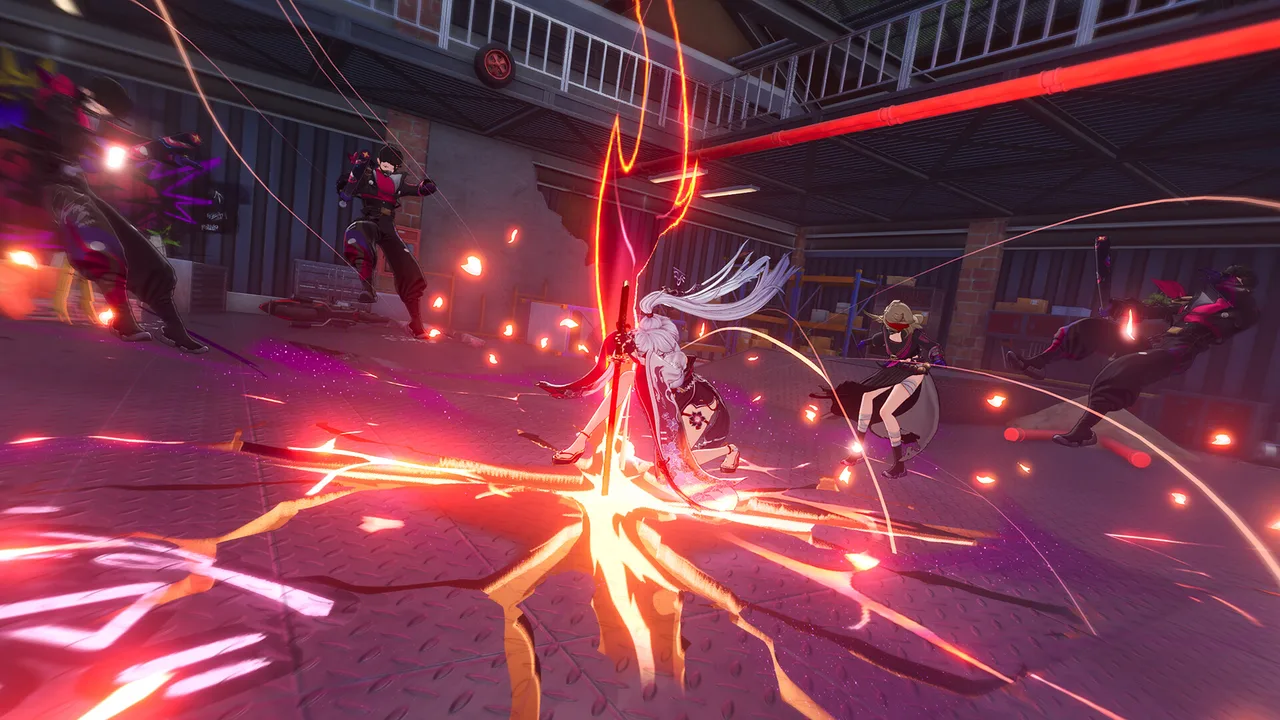
Hunter's Crucible is the clearest real-world test of this framework, since the event scores a clear instead of just passing or failing it. Community clear guides for the event routinely split into two tracks: a no-copies, no-signature-weapon build that leans on shielding, buff timing, and break-state combos to squeeze a strong score out of a base-kit roster, and a fully invested build that trades careful play for raw stat lines.
The no-copies track isn't a compromise run. It consistently posts respectable scores by leaning on positioning and cooldown management to close the damage gap that copies and signature weapons would otherwise cover on their own. That's the cost framework above playing out in practice: a team sitting at zero Awakening copies with no signature weapon isn't disqualified from high-level content — it just asks more of the player running it. Whether that trade is worth it comes down to whether time is better spent optimizing rotations or optimizing pulls, and that's a fair trade either way, not a consolation prize.
The Bottom Line
Guaranteed rate-up pulls, an Awakening system with a real floor at zero copies, and weapon pity that stacks predictably rather than punishing bad luck all make the line between "F2P" and "spender" genuinely blurry in NTE — arguably the healthier problem for a live-service game to have. The strict definition still matters when the subject is a specific account, but for judging a team composition, counting copies and signature weapons beats arguing over a label every time.
If the goal is assembling that first four-character team, the Esper type and class type breakdown covers the synergy layer this cost framework sits on top of. And for anyone still deciding whether Hethereau is worth the time investment at all before worrying about pulls, our full verdict on NTE covers the game beyond the gacha. For the characters and banners arriving next, see our Version 1.3 update coverage.
Zero-copy team in hand? Time to put it to the test. Play now →
Affiliate link: if you download or buy through it, raidrig earns a commission, at no extra cost to you.